235 (Crisis of 3rd Century)
The Roman Empire, at its zenith, appeared an unshakeable colossus. Yet, a perfect storm of internal decay and external pressures would bring it to its knees. What were the catalysts for this near-collapse, and how did the empire pull itself back from the brink of annihilation?
The Seeds of Crisis
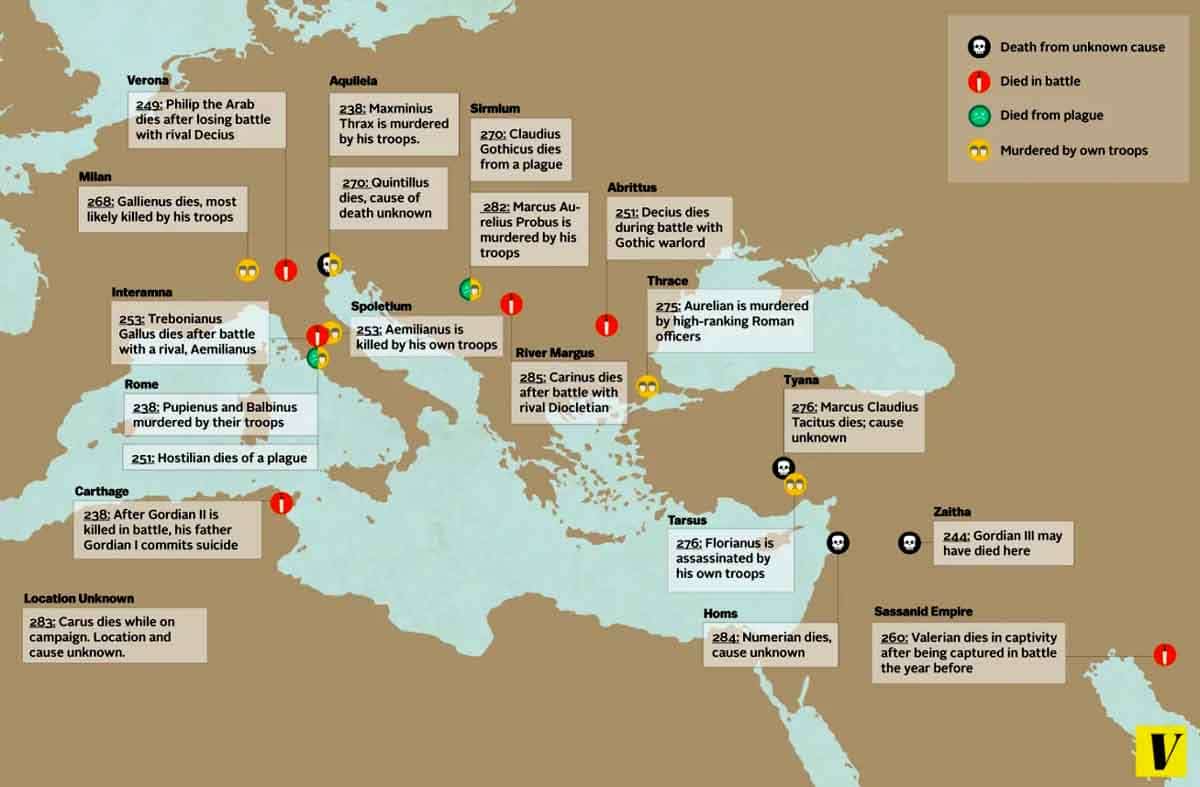
The Crisis of the Third Century was a tumultuous 50-year period, beginning in 235, marked by profound political instability and the fragmentation of the Roman Empire. During this time, at least 26 emperors—often called the "Barracks Emperors"—vied for power, with many reigning for only a few months before being overthrown.
A significant shift occurred in the perception of imperial authority. While emperors were no longer deified as in earlier times, they still held a divine association, though this was no longer tied to their lineage but rather their ability to command the loyalty of the military.
Religious Shifts and Imperial Reforms
In 274 AD, Emperor Aurelian instituted the cult of Sol Invictus ("Unconquered Sun") as an official state religion, in an effort to unify the empire under a single deity. While some traditional accounts claim a temple dedication on December 25, 274, modern scholars question this, citing a lack of evidence for a Sol festival on this date before the mid-4th century.
The End of the Crisis
The crisis ultimately drew to a close with the ascension of Diocletian as emperor in 284. He implemented sweeping reforms, including the establishment of the Tetrarchy—a co-emperor system—which brought stability and a clear line of succession, finally ending the cycle of chaos.
Conclusion
The Crisis of the Third Century was a defining period in Roman history, characterized by political instability and a rapid succession of emperors. The era saw significant religious reforms, including the rise of the cult of Sol Invictus, and ultimately concluded with the stabilizing reforms of Diocletian. This tumultuous period forever altered the Roman Empire, paving the way for the profound changes of Late Antiquity.