1st Century (Gnosis)
What if the early Christian church wasn't the only interpretation of Jesus' teachings? What if another, more mystical movement existed alongside it, one that saw the material world as a prison and salvation as a secret knowledge? This was the world of the Gnostics, a diverse group of thinkers who challenged the very foundations of what would become mainstream Christianity. This article explores the origins, core beliefs, and the surprising parallels between these two ancient faiths.
Origins
Acts 8:9-24 possibly refers to Simon Magus as a Gnostic teacher. Whether he originated Gnosticism is debatable, however from this we can see that Gnosticism was already active when the first Christian gatherings were formed.
Like Christianity, Gnosis also originates from the Middle East.
Core Gnostic Beliefs
Gnostic philosophy is complex, with many variations, but some common themes include:
- Dualism: A distinction between a good, spiritual world and an evil or flawed material world.
- The Divine Spark: The belief that human souls are divine "sparks" from the spiritual world, trapped in material bodies.
- The Demiurge: The material world was not created by the ultimate, good God, but by a lesser, often ignorant or malevolent being called the demiurge. For some Gnostics, this was the God of the Old Testament.
- Gnosis (Knowledge): Salvation is achieved not through faith or good works, but through "gnosis," or secret knowledge, which awakens the divine spark and allows it to return to the spiritual world.
These ideas were in sharp contrast to the teachings of the emerging proto-orthodox Christian church, which condemned them as "heresy."
Potential Influence on Christianity
While fundamentally different, some Gnostic concepts have parallels in Christian thought. It is a subject of scholarly debate whether these represent direct influence or coincidental development. The following table highlights some of these similarities, while also noting the subtle but important distinctions.
| Gnosticism | Christianity | Biblical facts |
|---|---|---|
| God is remote and unknowable. | God the Father in Heaven is mysterious. Therefore we should worship Jesus. | Jesus' main purpose was not to glorify himself but to present and reconcile us with God the Father for God's glory. |
| There are many aeons within one God. | There are three members within one godhead. | There is only one God. |
| Aeons are emanations of one God. | Members of the godhead are of the same substance of one God. | Jesus and God are distinct persons. |
| Jesus is an Aeon, an emanation of God. | Jesus is a member of the godhead. | There is no "godhead". |
| God resides in the Pleroma. | God resides in the Heaven. | God is omnipresent and involved on earth (Psalm 139:7–10; Jeremiah 23:23–24; Acts 17:27–28; Matthew 28:20). |
| A lesser being created the universe. | Jesus created the universe. | God Himself (without any help) created the universe. |
| The material world is a prison. | Christians go to Heaven. | The Bible never said anyone will go to Heaven. Instead we will be resurrected to live on a new Earth. |
| Only the mediator can bridge the gap between the material and spiritual world. | We need to pray through Jesus, our mediator, to God. | Jesus taught that we should directly address God, the Father in prayer (Matthew 6:9; John 16:23). |
| Jesus was sent from the Pleroma to aid humanity. | Jesus was sent from Heaven to aid humanity. | Idioms such as "from heaven" (e.g. John 3:13, John 6:38) primarily describe something good from God. Does not mean a person or object literally materialized out of the Heavenly spiritual realm. |
| Jesus appeared as a human but was still an Aeon. | Jesus appeared as a human, but was 100% God at the same time. | Jesus was a real human. |
| You need to have enough gnosis (secret knowledge) for salvation. | Your need to have enough faith (blind trust without evidence) for salvation. | The bible, God's miracles and nature present testimonies and evidence that "can have faith" (trust) in God. |
| Tended towards asceticism and withdrawal from the world | Christianity is a private matter. End-time Christians should hide from the world. | Jesus commissioned his disciples to live in the world despite persecution. |
| The Gnostic cross symbol. | The Christian cross symbol. | Neither God, Jesus nor the apostles taught or presented any cross symbols. This was invented by the church. |
Note that not all gnostics and christians share the same views. This table only highlights where these religions could have influenced each other's views.
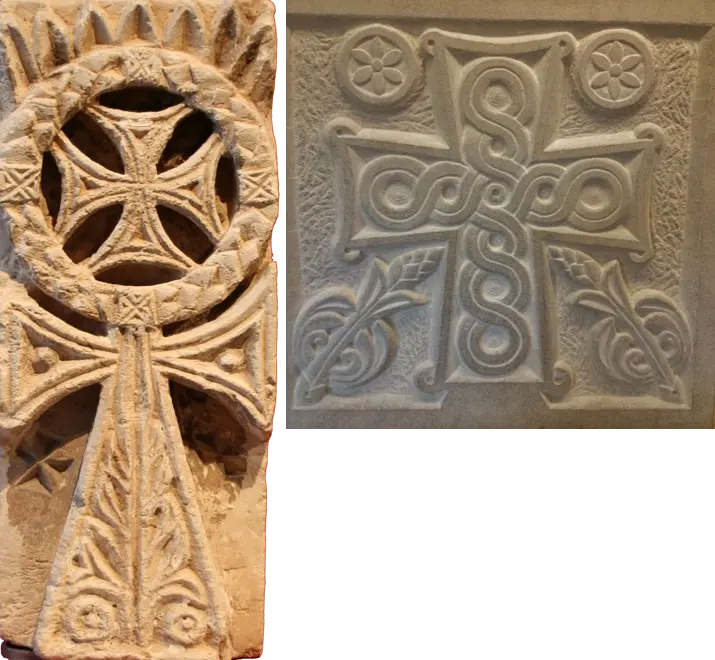
Gnostic cross (left) and Byzantine Christian cross (right).
Conclusion
Some beliefs long accepted in Christian tradition may not come from the Bible but from outside influences like Gnostic ideas. You should test your doctrines against the Bible, trace their origins, and reject teachings that contradicts the inspired Word of God. Do not assume an idea is Christian simply because it is old or widely held by the majority of Christians.